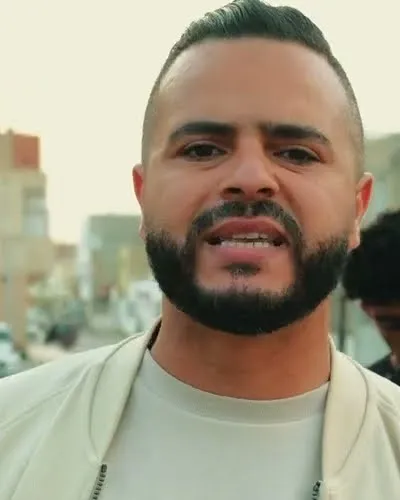
El Général
Also known as: El General · El Général · الجنرال · حمادة بن عمر · Hamada Ben Amor
Bio
Tunisian rapper from Sfax, born Hamada Ben Amor in 1989. Barred from concerts and radio under Ben Ali, he put his songs online. On 7 November 2010 he released Rais Lebled, addressing the president directly about corruption and unemployment; it became the anthem of the Tunisian revolution and was sung by protesters in Cairo's Tahrir Square. On 6 January 2011, after his song Tounes Bladna, police arrested him at his parents' home and interrogated him for three days, then released him under pressure from the street. TIME named him among the world's 100 most influential people of 2011, and he still releases songs today.
- Country
- Tunisia
- City
- Sfax
- Scene
- Sfax
- Active since
- 2008
Sourced facts
Hamada Ben Amor, born on 7 October 1989 and raised in Sfax in a middle-class family: his mother runs a bookshop and his father is a hospital medic. He started rapping at eighteen, influenced by Tupac Shakur; his first songs were Malesh (Why?) and Sidi Rais (Mr President)
Why this level: The birth date comes from Wikipedia alone; the rest from TIME and The Guardian.
Under Ben Ali he was barred from concerts, records and radio, so he put his songs on Facebook and YouTube with the help of two friends, one filming and one editing, by his own account
On 7 November 2010, the anniversary of Ben Ali's accession, he released Rais Lebled, addressing the president directly about corruption, unemployment and the lack of freedoms. Al Jazeera picked it up; his pages were shut and his phone cut off, and protesters sang it in Tunisia and then in Cairo's Tahrir Square, as the world press called it the anthem of the revolution
Why this level: The release date is 7 November per The Guardian, Foreign Policy and the title of its upload on his channel, and December 2010 per TIME.
On 6 January 2011, after his song Tounes Bladna, some thirty plain-clothes officers raided his parents' home in Sfax at dawn and took him to the Interior Ministry in Tunis, where he was handcuffed to a chair and questioned for three days about which party he worked for, by his own account. Reporters Without Borders documented his arrest that day. He was released under the pressure of the protests, days before Ben Ali fell
Why this level: The arrest date is 6 January 2011 per Reporters Without Borders, The Guardian and Foreign Policy, and 24 December 2010 per TIME, which also says the interrogators asked him to stop singing about the president and his family.
Milestones
Popularity and importance are two different things. These are the songs that changed something, each with the reason.
He addressed Ben Ali directly on the anniversary of his accession, about corruption and unemployment, and it became the anthem of the Tunisian revolution, sung by protesters in Tahrir Square. TIME credits it with helping inspire the uprising; Fanack considers that debatable.
The song after which police came to his parents' home at dawn on 6 January 2011; he was arrested and questioned for three days, per The Guardian and Foreign Policy.
He wrote it after his release as a tribute to those killed in the revolution, with a message to the region's countries and to the president yet to be elected, per TIME.
This ranking is the archive's editorial pick, not an official chart — and open to revision.
Most played
7,854,499 views on YouTube · as of 2026-10-06 [10]
3,824,986 views on YouTube · as of 2026-10-06 [14]
2,929,324 views on YouTube · as of 2026-10-06 [17]
1,388,385 views on YouTube · as of 2026-10-06 [11]
799,754 views on YouTube · as of 2026-10-06 [12]
781,049 views on YouTube · as of 2026-10-06 [19]
413,040 views on YouTube · as of 2026-10-06 [18]
Tracks (13)











Beefs
No documented beefs yet
We have no sourced beef or diss track for this artist. It appears here once a source or testimony arrives.
Timeline
Sources (21)
Discussion
This page's discussion has its own page. Go to the discussion