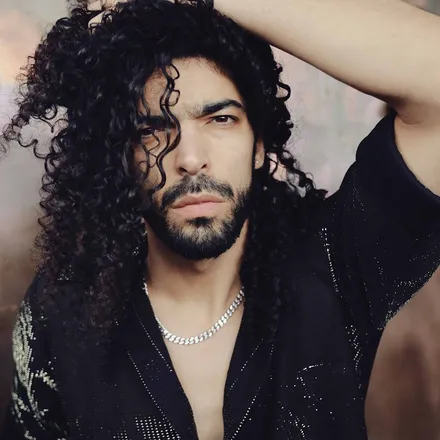
Ramy Essam
Also known as: Ramy Essam · رامى عصام
Bio
Egyptian singer and musician from Mansoura, born in 1987. During the 25 January 2011 revolution he took his guitar to Tahrir Square and turned the protesters' chants into songs; Irhal became the square's anthem and earned him the title “voice of the revolution”. He was arrested on 9 March 2011 when the army cleared the sit-in and was tortured in the Egyptian Museum; his songs and concerts were later banned in Egypt, and in 2014 he left for Malmö, Sweden, with the International Cities of Refuge Network. After Balaha (2018), a satire of Sisi's rule, its lyricist Galal El-Behairy and the video's director Shady Habash were arrested; Habash died in pretrial detention in May 2020. His most-viewed song on his channel is Lessa Bahinlha (2017), and he sang Segn Bel Alwan (2016) with Malikah and The Camp (2017) with PJ Harvey.
- Country
- Egypt
- City
- Mansoura
- Scene
- Cairo, then Malmö, Sweden
- Active since
- 2009
Sourced facts
Born in 1987 in Mansoura, where he studied architecture for three and a half years before the revolution. He learned the guitar at 17 and founded the band Mashakel in 2009
Why this level: Birth year and place from both sources; his studies from the English article; the guitar and the band from the Arabic one alone.
He came from Mansoura to Tahrir Square on 30 January 2011, camped with the protesters and set their chants to music. Among them was Irhal, calling on Mubarak to leave, which became the anthem of the protests and spread through YouTube
Why this level: The date he reached the square comes from Arabic Wikipedia alone.
When the army cleared the Tahrir sit-in on 9 March 2011 he was arrested along with more than a hundred people and taken to the Egyptian Museum, where he was tortured for about four hours, beaten with sticks and iron bars and given electric shocks, by his own account
Why this level: The date, the museum and the means of torture come from his account to NPR days after the event. The duration (about four hours) comes from his account in Arabic Wikipedia.
In 2013 his songs were banned in Egypt and he was barred from performing; after the 2014 presidential election he was detained and questioned over his songs against the police. He left Egypt that year for Malmö, Sweden, where he was a resident of the International Cities of Refuge Network (ICORN) until 2016
Why this level: The move to Malmö comes from both sources; the ban and the questioning from Wikipedia alone.
He released Balaha on 26 February 2018, a satire of Sisi's rule with lyrics by the poet Galal El-Behairy. Several people linked to him and the song were then arrested, among them El-Behairy, who was sentenced to three years in prison over an unpublished collection of his poems, and the video's director Shady Habash, arrested on 1 March 2018, who died in Tora prison in early May 2020 after more than two years of pretrial detention without trial. A rights statement signed by the Cairo Institute for Human Rights Studies held the Interior Ministry and the Public Prosecution responsible for his death. The authorities revoked Ramy's passport
Why this level: Sources differ on the number arrested (six, seven or eight) and on the day Shady Habash died: 1 May per Wikipedia, the morning of 2 May per the Cairo Institute.
Manshourat, made of the square's songs, then El Masala (2012) and Mamnoua' (2014), and A Letter to the UN Security Council (2017) with Universal Music MENA, mixing re-recorded older songs and new ones
Why this level: The sources disagree on the year of Manshourat: 2011 in the English article, 25 January 2012 in the Arabic one.
Milestones
Popularity and importance are two different things. These are the songs that changed something, each with the reason.
The anthem of the Tahrir Square sit-in during the 25 January revolution, calling on Mubarak to leave; it earned him the title “voice of the revolution”. Time Out ranked it in 2011 as the third most world-changing song, per Wikipedia.
A satire of Sisi's rule with lyrics by Galal El-Behairy. After its release, its lyricist and the video's director Shady Habash were arrested; Habash died in pretrial detention in May 2020, per Wikipedia and the Cairo Institute for Human Rights Studies.
Built on a poem by Galal El-Behairy that gave its name to his second collection, about women's situation, their resistance to oppression and equality. It became one of the most-watched videos in Egypt in the weeks after its release, per Wikipedia.
His most-viewed song on his channel, with more than 55 million views (2017).
This ranking is the archive's editorial pick, not an official chart — and open to revision.
Most played
55,886,262 views on YouTube · as of 2026-09-29 [14]
8,969,594 views on YouTube · as of 2026-09-28 [16]
2,269,646 views on YouTube · as of 2026-09-29 [27]
1,949,974 views on YouTube · as of 2026-09-29 [31]
1,940,619 views on YouTube · as of 2026-09-29 [26]
1,906,877 views on YouTube · as of 2026-09-29 [23]
1,225,854 views on YouTube · as of 2026-09-29 [21]
1,186,926 views on YouTube · as of 2026-09-29 [20]
917,391 views on YouTube · as of 2026-09-28 [22]
Tracks (24)
 2023Fiskooti MootiAvailable
 2021MuqawmaAvailable
 2020Prison Doesn't Kill, Loneliness DoesAvailable
 2020El Amiis El KarooAvailable
 2018BalahaAvailable
 2017Lessa BahinlhaAvailable
 2017The CampAvailable
 2016Segn Bel AlwanAvailableMalikah
 2016El Camera BethezzakAvailable
 2016A Letter to the UN Security CouncilAvailable
 2016Fanni Al MakiajAvailable
 2016MesahsahatyAvailable
 2015Foul CaviarAvailable
 2014Ya 7akakeenAvailableMalikah
 2014Ahd El ArsAvailable
 2014Ah Ya BaladAvailable
 2014Lonek El MakhtoufAvailable
 2012Ya Magles Yabn El HaramAvailable
 2012El Gahsh Wel HomarAvailable
 2012Ana El Sa7yAvailable
 2012HararaAvailable
 2011IrhalAvailable
 2011Eish Horreya Adala EgtemaeyaAvailable
 2011Taty TatyAvailable
Beefs
No documented beefs yet
We have no sourced beef or diss track for this artist. It appears here once a source or testimony arrives.
Timeline
Sources (33)
Discussion
This page's discussion has its own page. Go to the discussion